Event Recap

How to Get Your First 100 Customers for Your Tech Startup

23 April 2026  ·  Microlab Eindhoven  ·  By Eindhoven Entrepreneurs

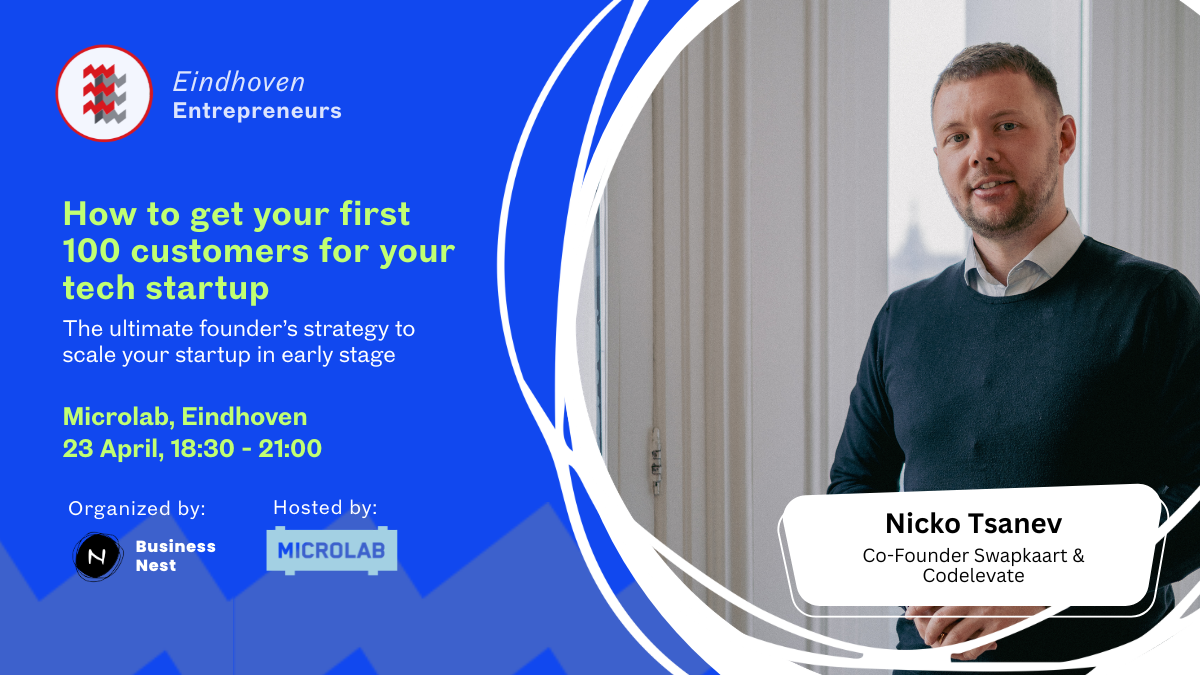
On 23 April 2026, Eindhoven Entrepreneurs hosted a keynote session at Microlab Eindhoven led by Nicko Tsanev, founder of Swapkaart and Codelevate — a product studio that has helped launch 120+ companies. The evening brought together founders, freelancers, and builders from the Brainport region for an honest conversation about early traction: what works, what does not, and why most founders get the order completely wrong.

3 Key Takeaways

1

Don’t ask. Show. Put your product in front of people as early as possible.

2

Your first 10 customers matter most. They are your feedback loop, your proof, and your foundation.

3

Validation beats perfection. If they won’t pay for it broken, they won’t pay for it polished.

“One weekend. Spent €3. Ten paying customers in 48 hours. That is not a growth hack. That is what happens when you stop polishing and start showing up.”

Nicko Tsanev, founder of Swapkaart & Codelevate

Meet Mike. You Might Recognise Him.

Mike had a great idea. A marketplace for tiny houses in the Netherlands. He spent six months building it, working every weekend and holiday. The platform half-worked. He hadn’t shown it to anyone.

So he hired an external vendor, burned through his savings, and spent another three to six months polishing every screen and every flow. Launch day came. A LinkedIn post. “Congrats!” His mum shared it.

Week one: zero customers. Month one: zero customers. Month two: a few signups. They left. The feedback? “It’s too complex.” “I don’t understand what it does.” “Why would I use this instead of Airbnb?”

Twelve months. €50,000 spent. Zero paying customers. Nicko’s point was simple: Mike is not a bad founder. Mike just did everything in the wrong order.

The €3 Alternative

Nicko had an annoyance, not just an idea. At networking events, exchanging contacts was overcomplicated and he was tired of it. So he bought a €3 NFC card from Bol.com. It arrived the next day. He spent one weekend writing code: no login, no payments, no pitch deck. A working proof of concept, nothing more.

He used it himself at an event in Amsterdam. Someone saw it happen, understood it immediately, and wanted it. Forty-eight hours later: ten paying customers.

Mike: 12 months, €50,000, zero customers. Nicko: one weekend, €3, ten customers in under five days.

Why 42% of Startups Never Find a Single Customer

According to CBS Insights research cited in the talk, 42% of startups fail because there was no market need. They built something nobody wanted to buy. Running out of money is the symptom, not the cause.

The pattern Nicko sees at Codelevate every week is the same: founders who mistake movement for progress and perfectionism for a strategy.

The Playbook Nicko Shared on the Night

Be the customer you are building for. If you don’t live the problem, find a co-founder who does.

Write the names of ten real humans before you write a single line of code. Text them weekly.

Build a working proof of concept with AI. Not a Figma prototype. A real thing. An afternoon, not a month.

Show it. Don’t pitch it. Pitching triggers defences. Demonstrating triggers curiosity.

Take money before it is polished. That is the only signal that matters.

Remove features. Don’t add them. The discipline to not ship is the new founder superpower.

How You Get From Ten Customers to a Hundred

Find the public moment inside your product. The moment a stranger sees a customer using it, understands it, and wants it.

Take inspiration from the market leaders: Calendly (every shared link is a demo), Loom (every sent video sells the product), Notion (every shared page teaches what it is). None of them got there by buying ads. Their customers were the ads.

For Swapkaart, every tap of the NFC card was a demo. Every demo was a referral. Nicko’s job from ten customers to a hundred was straightforward: get digital cards into hands faster.

One Question to Sit With Tonight

Where, inside your product, is the moment someone else sees it happen?

If you can name it, that is your growth engine. If you cannot, stop building. Put down the polish and find your ten humans first. A startup is not built in your head. It is built in contact with reality.

This blog is based on the keynote by Nicko Tsanev at the Eindhoven Entrepreneurs event on 23 April 2026 at Microlab Eindhoven.

Want to be in the room for the next one?